Every flower has a window. Buy inside it and you get better stems, a longer vase life and a lower price; buy outside it and you are paying a premium for something that was grown under lights or flown in cut tight. This is the list we work from at the market, month by month, with the honest notes about what is worth refusing.
Why seasonality is not a marketing word
A flower bought in its natural window has usually travelled less, been cut at a more open stage, and cost the grower less to produce. All three show up in your vase. A peony in July, grown outdoors in the Hudson Valley, will open over four days and hold for a week. The same peony in December has been cold-stored for months, costs three times as much, and often opens unevenly — one flower collapses while the bud next to it stays shut.
That is the practical argument. There is an aesthetic one too: flowers that are in season arrive in quantity, and quantity is what lets a bouquet look generous rather than rationed. Three stems of something scarce always look like three stems. Twenty stems of something abundant look like a gesture.
January and February
The hungriest months in the northern market. Most of what is beautiful is either forced or imported, and both are worth buying selectively.
- Tulips — Dutch and local forced crops are everywhere and cheap. They keep growing in the vase, which people either love or hate. Buy them closed and let them open in the room.
- Narcissi — paperwhites and the smaller poeticus. Strongly scented, and their sap shortens the life of other stems; condition them alone for six hours before mixing.
- Ranunculus — the best value of the month. Tight, layered buds that open over a week in cool water. Look for stems that are firm, not hollow at the base.
- Anemone — dramatic, short-lived, and worth it for a small arrangement. They close at night, which some people find charming and others find broken.
- Hellebore — the garden flower of the moment. Short stems, so use them low; they last longer than their reputation suggests if you score the stem base.
What to refuse: long-stemmed roses in the second week of February. The price triples for a flower that has been in cold storage since November. If you want roses for Valentine's, buy garden roses a week earlier or choose a mixed bouquet in red and burgundy instead — you will get better flowers for the same money.
March and April
The market turns. Bulbs arrive in volume, prices drop weekly, and the first local stems appear.
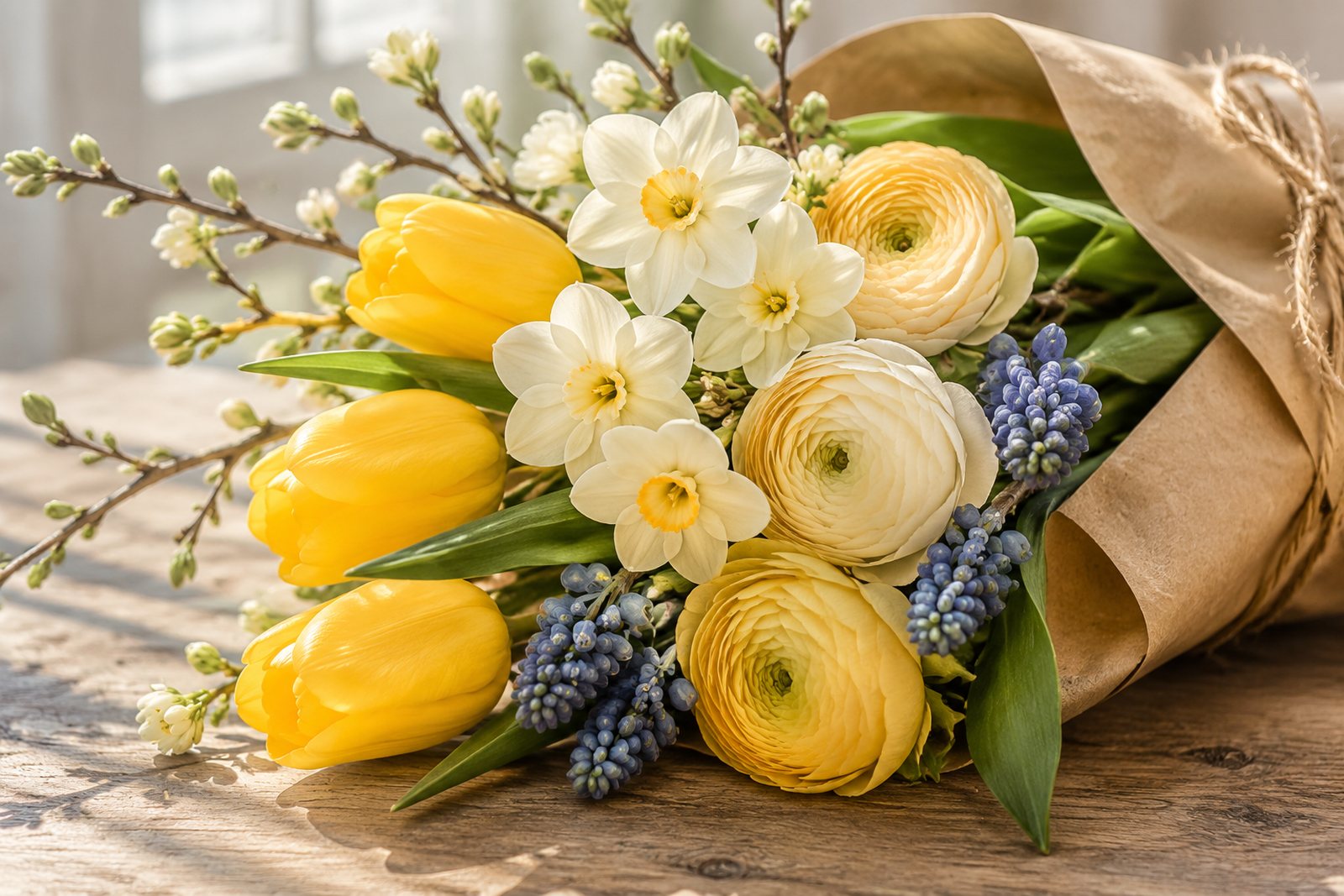
- Tulips — peak. French and local varieties, including the fringed and double forms that cost a fortune in January.
- Hyacinth and muscari — cheap, heavily scented, excellent in low bowls. Hyacinth stems are heavy and need support in a tall arrangement.
- Lilac — brief, usually three weeks. Buy it in bud, smash the stem ends with a hammer, and it will drink. Lilac that arrives already open will not last the week.
- Ranunculus — still strong, and now in colour ranges rather than just blush.
- Sweet pea — starts late in the month in a warm year. Fragile, short-lived, and worth every day it gives you.
What to refuse: imported peonies in March. They exist, they are expensive, and they almost never open properly. Wait six weeks.
May and June
The best six weeks of the flower year, and the reason the studio runs a peony season rather than a peony product.
- Peony — from late April to early July depending on the variety and the weather. Buy in bud, with the petals just showing colour. Do not buy open peonies for a delivery two days away.
- Iris — German and Dutch. Dramatic, short-lived, and best bought in bud. The scent is divisive; we love it.
- Allium — architectural, long-lasting, and the one flower that reliably holds a tall arrangement together.
- Stock — the workhorse of the season. Spicy scent, strong stems, and a colour range from white through apricot to deep purple.
- Nigella — delicate, cheap, and better in a meadow arrangement than a formal one.
What to refuse: nothing much. This is the window where almost everything is worth buying, and where a florist who says “the market is poor” is usually telling you about their own order rather than the market.
July and August
Heat changes everything. Stems travel badly, water goes warm, and flowers that lasted a week in May last four days. Buy earlier in the day and condition faster.
- Dahlias — start in July and peak in September. Hollow stems, so cut long and put them straight into deep cool water.
- Cosmos — the most generous summer flower. Cut in the morning, strip the lower leaves, and change the water daily.
- Zinnia — strong stems, strong colour, surprisingly long vase life if you cut above a leaf joint.
- Sunflower — cheap and cheerful; buy them just open, not fully flat, and use a heavy vase because they tip.
- Scabiosa and lavender — for texture and scent. Lavender dries well if you hang it before it drops.
What to refuse: long-haul imports in a heatwave. A rose cut in Ecuador and driven around a 35°C city is a rose that will not see the weekend.
September and October
The second peak, and the most underrated. Dahlia at its best, chrysanthemums arriving, seed heads and berries everywhere.
- Dahlia — the widest colour range of any flower in the year. Buy in the morning; they are at their worst in the afternoon heat.
- Chrysanthemum — the florist's workhorse, unfairly dismissed as a supermarket flower. The bronze and rust varieties are excellent and last two weeks.
- Hydrangea — if you want it to dry in place, do not put it in water. If you want it fresh, sear the stem ends.
- Seed heads and grasses — free texture, and the thing that makes an autumn arrangement look like a season rather than a colour scheme.
- Berries — hypericum, rosehips, viburnum. Handle them gently; bruised berries drop within a day.
What to refuse: the first forced amaryllis of the year, which appears in October and is always worse than the ones that arrive in December.
November and December
Dark, scented, and more interesting than the market suggests. The trick is to lean into foliage rather than chase colour.
- Amaryllis — big, architectural, and the one bulb flower that justifies its winter price. Buy the stems with two or three open flowers and two buds.
- Hellebore — back again, and better than in February because the stems are longer.
- Evergreen branches — cedar, fir, pine, eucalyptus. Buy them for scent and structure; they hold for weeks without water.
- Narcissi — paperwhites forced for the holidays. Same rule as January: keep them separate for the first night.
- Cyclamen and helleborus in pots — the plant equivalent of a winter bouquet, and far more sensible than cut flowers for a cold hallway.
How to read a market in five minutes
Walk the floor once without buying. Look at what is in every bucket, not what is in the first three. Then ask three questions: what is cheapest this week, what is at its peak, and what is nearly finished. The answers give you the bouquet — the cheap flower for volume, the peak flower for beauty, and the nearly-finished flower only if you are using it that day.
Then look at the stems, not the heads. A bucket of beautiful flowers with yellowing leaves and slimy water is a bucket of flowers that will die in your cooler. Conditioning starts at the market, not at the bench.
Three questions worth asking a florist
If you are buying from someone other than us, three questions will tell you most of what you need to know. First: what came in this week? A florist who can answer without looking at a list is buying fresh. Second: how many stems are in this bouquet, and what size is it? If the answer is vague, the bouquet is probably smaller than the photograph. Third: what happens if a stem fails? A shop that replaces without argument is a shop that expects its flowers to last.
Ask them in that order. The answers are more useful than any style guide, and they apply whether you are spending forty dollars or four hundred.
What we do differently
We buy twice a week, on Tuesday and Friday, and we write the week's list after we have seen the floor rather than before. That means the collection pages on this site describe a type of bouquet rather than an exact recipe — and it means that if you ask for something out of season, we will tell you what it will cost and how long it will last before you pay.
If you want to know what is good this week, the Friday note is the honest answer: what came in, what is nearly gone, and what we are making with it.
The Friday note
What came in, what is nearly gone.
A short letter every other Friday from the studio bench: what the market had, which flowers are peaking, and what we are making with them.
No more than two emails a month. Unsubscribe in one click.