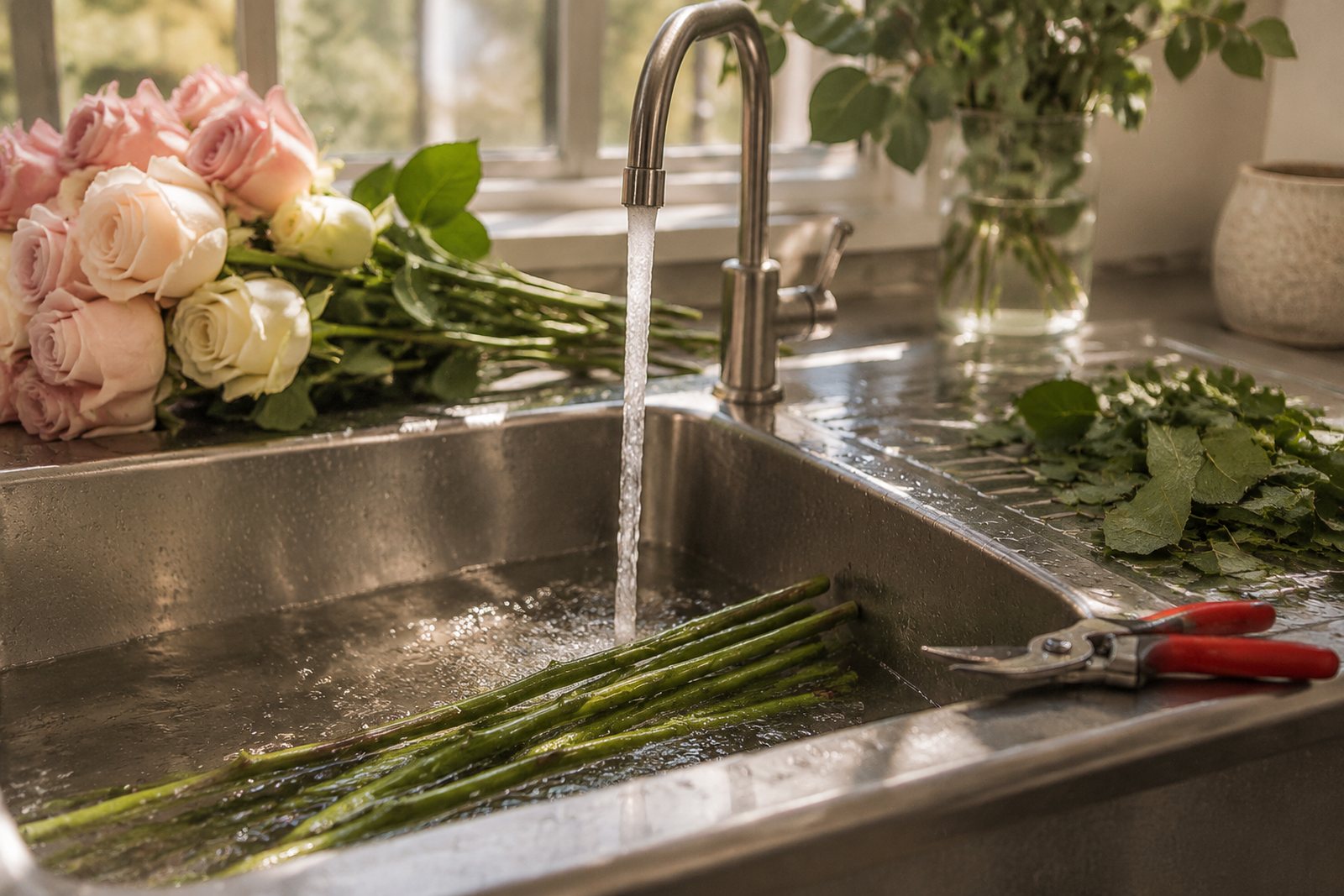
Most bouquets die of thirst and bacteria, not of old age. The twenty minutes you spend when the flowers arrive decide whether you get five days or nine — and almost none of it is folklore. Here is the routine we use at the bench, and why each step matters.
First: unwrap, do not admire
Flowers travel in paper or a box, and both hold ethylene — the gas that ripening fruit and dying leaves release, and the single biggest accelerant of flower ageing. Leave a bouquet wrapped on a table overnight and you have given it a day of its life for nothing. Unwrap it, lay it out, and get the stems into water within the hour.
If the bouquet came with a water source, keep it. If it came dry, do not panic — most flowers tolerate twelve hours out of water if they are cool. What they do not tolerate is twelve hours in a warm car.
Cut at an angle, with something sharp
Stems seal themselves at the cut. A clean angled cut gives the largest possible surface for water uptake and stops the stem sitting flat on the bottom of the vase. Use snips or a knife; scissors crush the stem and close the water channel, which is why a bouquet cut with kitchen scissors often droops within a day.
Cut two to three centimetres, at roughly 45 degrees, and do it under water if you can. Cutting under water prevents an air bubble from entering the stem — the same principle as bleeding a brake line. For roses and dahlias, this single step is worth two days.
Strip everything below the waterline
Leaves under water rot. Rotting leaves feed bacteria, bacteria block the stem ends, and blocked stems wilt even though the vase is full. Strip every leaf that would sit below the rim, and strip the thorns on roses if you have a stripper — they puncture neighbouring stems and give bacteria a place to start.
Clean vase, not a rinsed one
Bacteria live in the film on the inside of a vase, not in the water. Rinsing does not remove the film. Wash the vase with hot water and a drop of dish soap, scrub the base with a bottle brush, and rinse twice. If a vase has held flowers before and smells faintly of pond, it needs bleach, not soap.
Cool water, and the right depth
Most flowers prefer cool water — it slows metabolism and buys time. The exceptions are tropical stems (heliconia, ginger) and hydrangea, which take warm water. Depth matters too: roses and stock drink from the bottom third, tulips and dahlias want two-thirds, and soft-stemmed meadow flowers wilt if the vase is shallow.
Flower food: what it actually does
A sachet of flower food contains three things: a sugar for energy, an acidifier to lower pH, and a biocide to slow bacteria. All three matter, and the biocide is the one people skip. If you have no sachet, a quarter teaspoon of household bleach per litre plus a teaspoon of sugar gets you most of the way — but do not use both bleach and commercial food, and never use bleach on lilies or tulips, which are sensitive to it.
The myths, briefly
- A copper penny — does nothing. Copper is antimicrobial in quantity, but a penny in a vase releases almost none of it.
- Aspirin — mildly acidifies the water, which helps a little, but it does not feed the flower or stop bacteria. Flower food does both.
- Lemonade or soda — the sugar feeds the flower and the sugar also feeds the bacteria. Without a biocide you are trading one problem for another.
- Hairspray on hydrangea — seals the petals and slows wilting for a photograph, and shortens the life of the arrangement. Fine for an event, wrong for a gift.
- Warm water for everything — only true for hydrangea and tropicals. For everything else, cool is better.
Day three is the hinge
Change the water, rinse the vase, and re-cut one centimetre from every stem. This is the step people skip and it is the one that doubles vase life. You will be amazed how much slime is on the stems after three days; that slime is the colony that will kill the bouquet by day five.
Placement: the invisible variable
Four things shorten a bouquet's life faster than anything else: direct sun, a radiator, a fruit bowl, and a draught from a door. Ethylene from ripening fruit is the one people never suspect. A bouquet next to a bowl of bananas will age visibly in a day.
Also think about who is in the room. Lilies are toxic to cats, philodendron and many houseplants are toxic to pets, and strongly scented stocks and lilies are a problem in a hospital ward or a small bedroom. We flag both on the card and on the product pages.
If it droops anyway
Most droop is air in the stem, not death. Re-cut two centimetres under water and stand the stems in deep cool water for two hours in a dark room. Roses, hydrangea and dahlias usually recover. Tulips are the exception — they droop because they are still growing and reaching for light, not because they are short of water; a quarter turn of the vase each morning is the fix.
Hydrangea has its own trick: submerge the entire head in cool water for twenty minutes. The petals absorb water directly. It looks like a magic trick and it works about half the time.
A flower-by-flower cheat sheet
Conditioning is not one routine; it is a set of small adjustments. These are the ones that matter most across the flowers we sell.
- Roses — cut at an angle, strip thorns below the waterline, shallow water (about 8cm), cool room. Remove bruised guard petals rather than trimming them.
- Tulips — cold water, upright vase, and expect them to keep growing. Do not re-cut more than once; the stem is the flower's engine.
- Narcissi — condition alone for six hours. Their sap closes the water channels of other stems, and no amount of flower food reverses it.
- Dahlias — hollow stems, deep cool water, and no re-cutting after the first day. They are the flower most likely to collapse between morning and evening.
- Peonies — buy in bud, two-thirds water, top up daily. If they arrive open, they will last three days, not seven.
- Hydrangea — the exception to every rule: warm water, deep, and if the head wilts, submerge it entirely for twenty minutes.
- Lisianthus — soft stems that bend in old water. Change the water on day two or the bouquet will start to lean.
- Eucalyptus and evergreen — woody stems, smash or score the base, and they will last for weeks without much attention.
The first hour, in order
If you do nothing else, do these five things in this order: unwrap, fill a clean vase two-thirds with cool water, stir in the flower food, cut 2cm from every stem at an angle, and put the bouquet in a cool room away from fruit. That is the whole routine, and it takes about eight minutes. Everything else in this article is refinement.
The one thing to resist is rearranging. A bouquet is tied to hold its own shape; pulling stems out and pushing them back in breaks the spiral and shortens the life of the flowers that get bruised in the process. If a stem is too tall, lift the whole bunch and cut that stem at the base rather than pulling it free.
One last thing worth saying: the vase matters far less than the water in it. A jam jar changed every other day will outperform a crystal vase that is topped up and never emptied, and the flowers will not know the difference.
What we send with a bouquet
Every bouquet leaves with a printed card: the flower list, the stem count, and the three-step care routine above in short form. It is not there to sell you anything. It is there because a bouquet that lasts nine days is a better product than a bouquet that lasts five, and the difference is mostly information.
The Friday note
What came in, what is nearly gone.
A short letter every other Friday from the studio bench: what the market had, which flowers are peaking, and what we are making with them.
No more than two emails a month. Unsubscribe in one click.