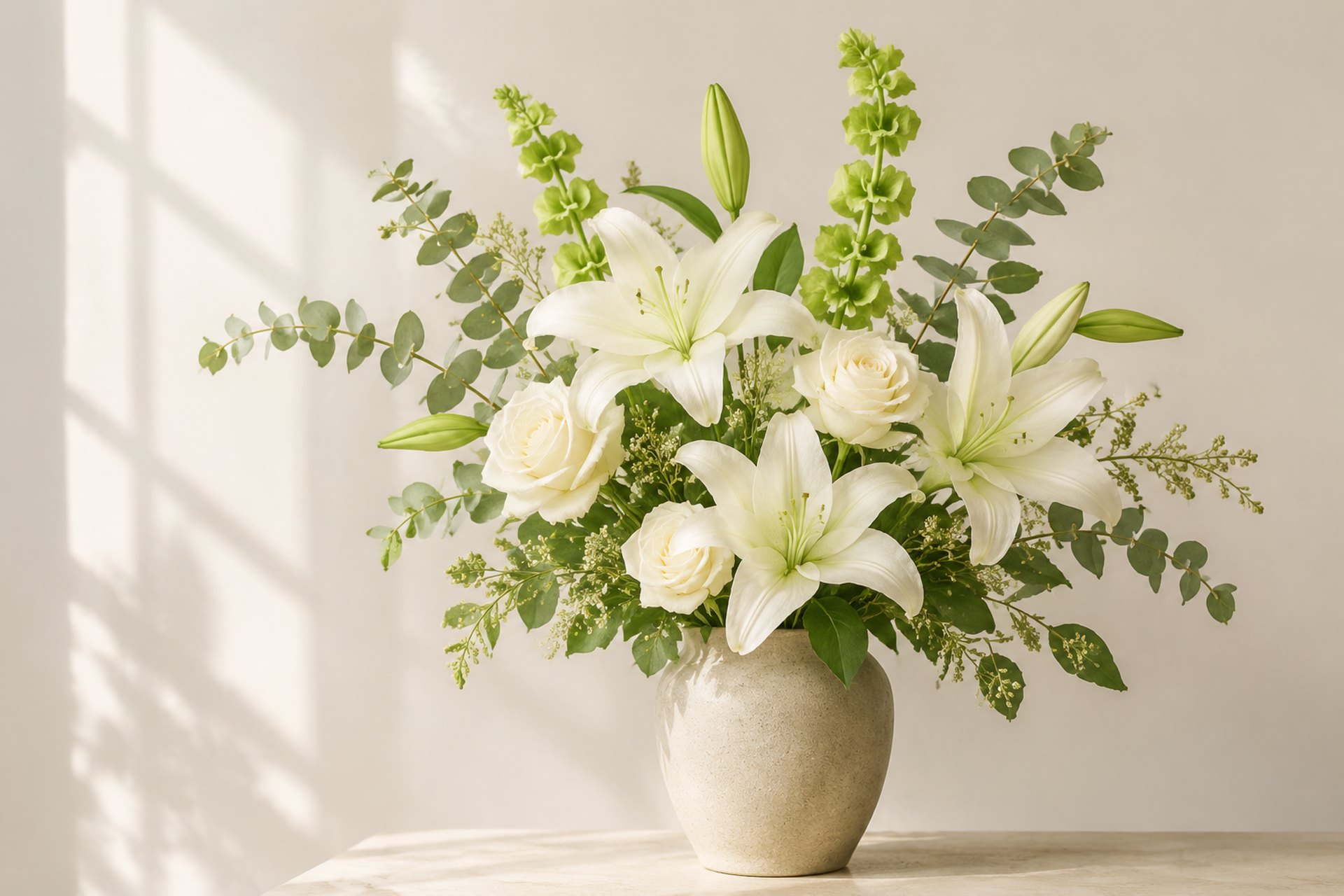
The flowers are the easy part. What people get wrong is the register — the difference between a birthday bouquet and one sent after a death is not the price, it is the palette, the shape, the timing and the four lines on the card. Here is how we think about the common occasions, including the ones nobody asks about.
Birthday: bright, open, on the day
A birthday is the one occasion where cheerful beats tasteful. Coral, yellow, a little clashing pink — the palette that would be too much at a wedding is exactly right here. Send it on the day, in the morning if it is going to an office, and keep the card short. “Happy birthday, I hope this year is a good one” is enough; a long message on a birthday card reads as a speech.
If you do not know the person well — a colleague, a client, a neighbour — choose a mixed seasonal bouquet rather than roses. Roses carry romantic weight in most English-speaking markets, and a dozen red ones sent to a colleague will be read as a message rather than a gesture.
Anniversary and romance: pick a register, not a colour
Red roses are shorthand, and shorthand is sometimes what you want. But if the relationship is past the shorthand stage, the better move is a palette rather than a symbol: blush and burgundy garden roses, or a soft pastel mix in peony season. It reads as chosen rather than ordered from a menu.
Timing matters more than variety here. A bouquet that arrives at the restaurant before you do is a better gesture than one that arrives at 9pm when you are already home. Ask the restaurant to hold it, and tell the florist the reservation time.
Proposals are their own logistics: a timed delivery, a backup bouquet in the cooler, and a florist who answers the phone. We do not put anything on the card that you have not written yourself, and we do not spoil surprises by calling the recipient to confirm.
Sympathy: white and green, low, and early
The instinct is to send something large. The better instinct is something calm: white and green, low enough for a hall table, arranged so it does not demand attention. A hand-tied bouquet the family can take home is often more useful than a formal arrangement that has to be left behind.
Send before the service if you can. After the funeral the house fills with flowers that all arrive at once and half of them are wasted. If you are late, send a plant instead — it does not compete with what is already there, and it lasts into the months when the cards have stopped.
Do not print a message on ribbon, and do not explain the loss back to the family. “Thinking of you and your family” is sufficient and never wrong. If you want to say more, say something specific and small: a memory, a quality you admired, an offer of a practical thing.
Two practical restrictions worth knowing: most hospitals do not allow lilies or soil, and lilies are toxic to cats. If you do not know the household, ask for a bouquet without them; we substitute at no cost.
New baby: not lilies, not a scented bomb
New parents are tired, the house is full of visitors, and the last thing they need is a bouquet that requires a vase they do not own. Send something low and already arranged, in a vessel they can keep, and skip the strongly scented flowers — stock, lilies and hyacinth are lovely and overwhelming in a small room with a newborn.
Pastel is the conventional choice and it is fine. A soft mix of peach, cream and a little green is better than the all-blue or all-pink cliché, and it will still be in the room when the grandparents have gone home.
Thank you, congratulations, apology
These three are the most common and the least considered.
- Thank you — send within a week, keep it modest, and name the thing you are thanking them for on the card. A thank-you bouquet with no specifics feels like a form letter.
- Congratulations — a promotion, a new house, a book. Brighter than a thank-you, smaller than a birthday. If it is for a workplace, send it to arrive after the announcement, not before.
- Apology — the hardest, because flowers cannot carry the whole message. Send them, but write the apology on the card in plain words and do not let the bouquet stand in for it. Avoid red roses; they read as an attempt to change the subject.
Corporate and workplace
An office arrangement has different rules: it has to survive a weekend, read from three metres, and not set off an allergy in a shared room. Green and white is the safe palette; a seasonal accent stops it becoming furniture. Send to reception with the recipient's name and team, not just the company, or it will sit unclaimed.
For a client, avoid anything that looks like a personal gift. A generous seasonal arrangement in a company palette is read as professional; a dozen red roses is read as a mistake.
What to write: four formulas that work
If you are stuck, use one of these and change a word or two. All four are short enough to write by hand.
- The specific memory — “I still think about the weekend in Maine. Happy birthday.”
- The plain wish — “Thinking of you this week. With love, A.”
- The acknowledgment — “Thank you for the thing you did in March, which I have not forgotten.”
- The no-words option — “No need to reply. Just wanted you to have these.”
What not to send
Do not send lilies to a house with cats, or to most hospital wards. Do not send strongly scented flowers to a small room, a sickroom or a workplace with a known allergy. Do not send red roses to a colleague, a client, or someone you have just apologised to. Do not send a plant to someone who travels constantly, and do not send a dried bouquet to someone who expects flowers that open.
And do not send anything with a logo on it. The card is the message; the flowers are the paper it is written on.
Cultural notes, briefly
Flower meanings are not universal, and sending the wrong colour is a real risk in a city as mixed as New York. White is mourning in many East Asian and some European traditions, and white chrysanthemums in particular are funeral flowers in Japan, Korea and China. Red can read as celebration in one household and as romance in another. If you are unsure, ask the recipient's family or send a plant — a plant carries no colour code.
Religious restrictions matter too. Some households will not keep lilies in the house at Easter, some will not accept flowers at all during mourning, and some hospitals and hospices refuse soil and strongly scented stems. None of this is exotic; it comes up most weeks at the studio, and a florist who has been told will not be offended by the question.
What flowers cost, and why
Three things drive the price of a bouquet: the stem count, the variety, and the week. A garden rose costs three times a supermarket rose because it is grown for petal count rather than shelf life. A peony in June costs a third of what it costs in December, if you can find one. And a bouquet made on Valentine's week costs more than the same bouquet made a fortnight later, because the market does too.
What should not drive the price is the wrapping. Paper, twine and a card cost us a few dollars; a bouquet that arrives in a hat box with a ribbon and a printed sleeve has usually been charged for the box. We would rather put the money into stems, and we say so on every page of this site.
Timing, in one table
Same-day in New York, Brooklyn, Queens and Jersey City by 2pm ET. Nationwide next day by 8pm local. For funerals, call rather than order online — the timing is usually tighter than a web form allows. For weddings and events, six to eight weeks is comfortable, four is possible outside peak season.
If you are not sure which occasion you are in, the safest bouquet is the Market Seasonal in a soft palette. It is hard to misread, and it is the one we send when we do not know the room.
The Friday note
What came in, what is nearly gone.
A short letter every other Friday from the studio bench: what the market had, which flowers are peaking, and what we are making with them.
No more than two emails a month. Unsubscribe in one click.